Post-2027 CAP: Turning Complexity into Action for Pollinators and Beekeepers
Updated: Sep 10
Language Note: this article was originally written in English. Automated translations may contain inaccuracies. For precise information, please refer to the English text. We appreciate your patience.
A new BeeLife report and interactive digital tool explore the current CAP, the opportunities and risks of the post-2027 framework, and how agricultural policy can better support pollinators and beekeeping.
The future of European agriculture cannot be separated from the future of pollinators.
Pollination is one of the ecological processes underpinning agricultural production. Yet, when looking at the design of agricultural policy, the links between farming, pollinators and beekeeping are not always immediately visible. Measures that can benefit pollinators may be spread across different areas of the CAP, while their contribution to biodiversity, agricultural resilience and the beekeeping sector is not always explicitly recognised.
This becomes particularly important as Europe prepares for the post-2027 Common Agricultural Policy (CAP).
Understanding what the CAP can deliver
The future CAP is expected to introduce important changes to the way agricultural support is structured and implemented. Greater flexibility for Member States could create opportunities to design measures that respond better to local conditions. At the same time, it raises important questions about the level of environmental ambition, the resources available and the safeguards needed to ensure that pollinator protection remains part of the agricultural policy framework.
Against this background, BeeLife has developed a comprehensive analysis of the current CAP and the proposals for the post-2027 period, with a particular focus on what they mean for pollinators, beekeepers and farmers.

The report examines the legal framework, the interventions currently available to Member States and the choices already made in national CAP Strategic Plans. It also explores how existing tools can be used to strengthen Pollinator Stewardship, and identifies opportunities and potential risks within the future CAP.
The analysis goes beyond apiculture-specific measures. BeeLife has assessed how interventions targeting farmers can also contribute to pollinator health and the beekeeping sector, recognising that supporting pollinators requires action across the agricultural landscape, not only within the beekeeping sector. The report's analysis covers thousands of interventions implemented across Member States, while the full dataset and methodology are made available through the interactive tool.
From analysis to practical recommendations
The report is designed not only to explain the CAP, but to help different stakeholders understand where action is possible.
For beekeeping organisations, it provides a basis for engaging with national authorities and advocating for stronger and better-targeted measures.
For farmers, it highlights how agricultural practices and CAP interventions can contribute to healthier pollinator populations and more resilient farming systems.
For national authorities and policy-makers, it identifies opportunities to integrate pollinator stewardship into the implementation of the CAP and highlights areas where stronger safeguards may be needed.
And for journalists and other stakeholders, it provides an accessible way to navigate a complex policy framework and understand its implications.
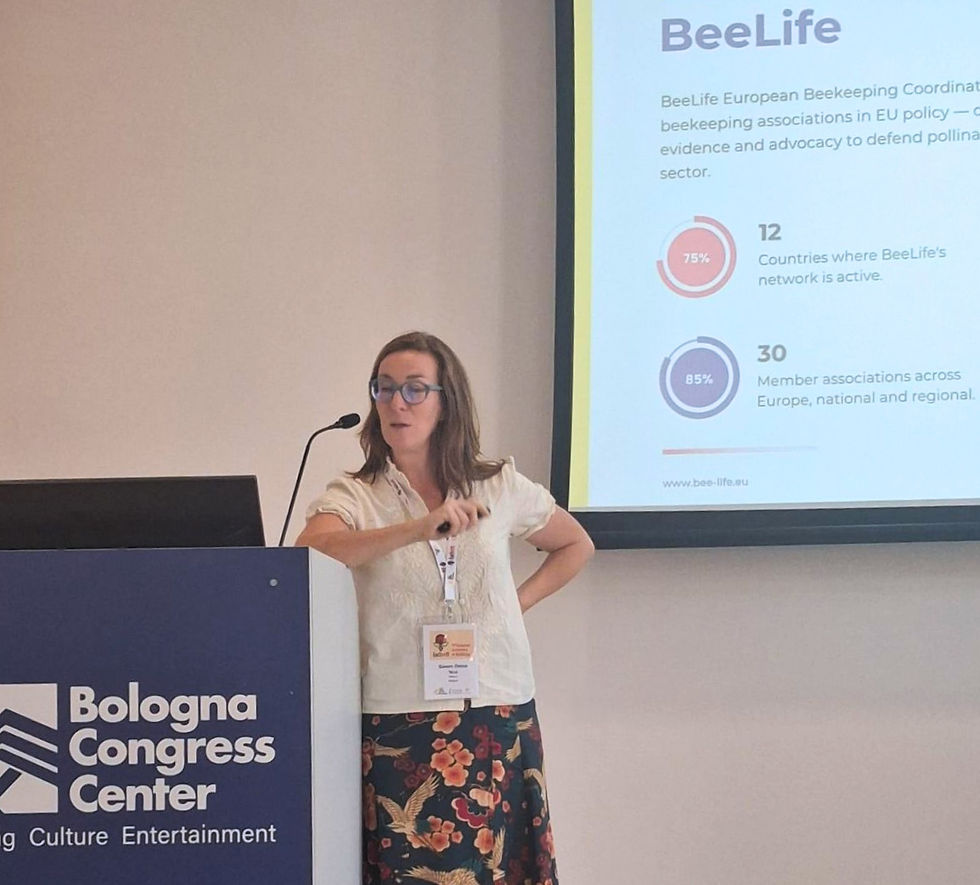
Noa Simon, Scientific Director at BeeLife, presents the BeeLife CAP Report at EurBee11 in Bologna
Explore the CAP through the BeeLife Digital Tool
To complement the report, BeeLife has also developed an interactive Digital Tool based on the EU Commission Database, designed to make the complexity of the CAP easier to explore.
The tool allows users to navigate the interventions implemented by Member States, compare different approaches and identify measures with potential benefits for beekeepers, farmers and pollinators.
The underlying analysis categorises interventions as Beekeepers4Biodiversity, Farmers4Biodiversity, Dual measures benefiting both groups, and Opportunities where the right implementation logic could generate benefits for pollinators.
The digital tool also makes the wider dataset accessible. The complete assessment covers 2,483 interventions and €300.2 billion in cumulative public expenditure at EU level, including interventions assessed as positive, neutral/unknown or potentially harmful under the Do No Significant Harm perspective.

Knowledge is the first step towards better choices
The CAP is complex. Its implementation involves different levels of governance, instruments and choices, and the future framework is still being negotiated.
But complexity should not prevent stakeholders from understanding how agricultural policy can shape the conditions in which farmers, beekeepers and pollinators operate.
By bringing together legal analysis, data, practical recommendations and an interactive digital tool, BeeLife aims to turn a complex CAP into shared knowledge — and shared knowledge into informed action.
Because a resilient agricultural future will depend not only on how much Europe invests in agriculture, but on whether those investments strengthen the ecological foundations that make agriculture possible.
Explore the BeeLife resourcesFor beekeeping organisations, farmers, national authorities, policy-makers and journalists.
Support for pollinators and beekeepers in the current and future EU Common Agricultural Policy
Navigate CAP interventions, explore opportunities and risks, and discover how agricultural policy can support Pollinator Stewardship.